
Safety first. If you see a wide or fast-growing crack with concrete falling, exposed rusty steel, a sagging ceiling, doors that suddenly jam, or you hear cracking sounds, leave the area at once and call Civil Protection (180), then an engineer.
The short answer: most fine cracks in plaster are on the surface and do not affect the structure, but diagonal or widening cracks, or cracks with rust stains or a sagging ceiling, need an engineer’s inspection. Identify the type, monitor it, and do not cover it until you know the cause.
Common types of crack
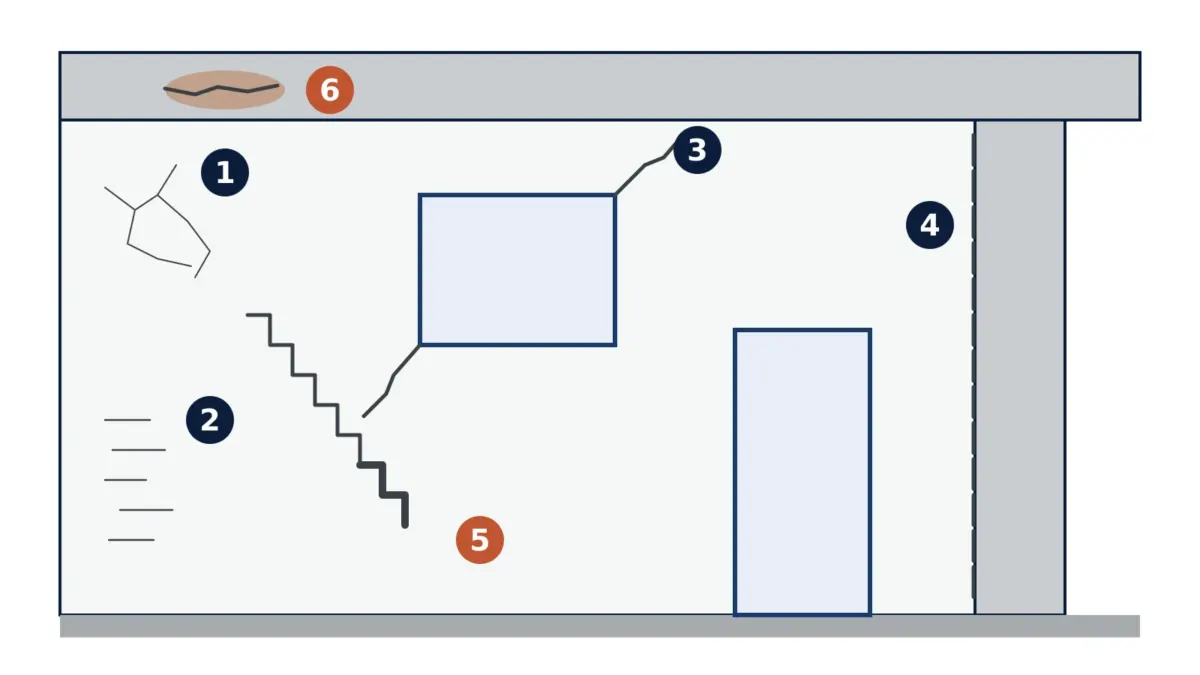
| Type | What it looks like | Likely cause | Initial severity | What to do |
|---|---|---|---|---|
| Hairline plaster cracks | Very fine scattered lines or a mesh pattern | Plaster shrinking as it dries | Usually minor | Treat when painting, once they are stable |
| Shrinkage cracks | Regular fine cracks over large areas | Drying too fast or an unsuitable mix | Usually minor | Monitor, then treat the surface |
| Cracks at the corners of openings | Diagonal, starting at the corner of a door or window | Stress concentration or no proper lintel over the opening | Needs monitoring | Monitor, and call an engineer if they widen |
| Wall-to-column joint | A straight vertical line where brick meets concrete | Brick and concrete moving differently | Usually minor | Treat with mesh when renovating |
| Diagonal wall cracks | At an angle, sometimes wider at one end | Foundation settlement or building movement | Needs a specialist check | Call an engineer and do not cover them |
| Ceiling cracks with rust | A crack with brown staining or falling concrete cover | Rebar rusting because of damp | Needs a specialist check | Stop the water source and call an engineer |
| Cracks in structural elements | Cracks in columns, beams or load-bearing walls | Overloading or a structural problem | Needs an urgent specialist check | Call a structural engineer at once |
How to monitor a crack
- Mark both ends of the crack with a pen and write the date next to them.
- Measure the crack’s width at one fixed point with a ruler or a crack-width card.
- Photograph it from the same spot and distance, for example every two weeks.
- If the crack grows past the marks or widens, it is active and needs an engineer.
What not to do
- Do not fill and paint over a crack before you know its cause: you hide an important sign.
- Do not remove walls or cut columns or beams without a design and a permit.
- Do not load the roof with tanks or extra floors without a structural study.
When is a specialist structural assessment needed?
When the crack is diagonal and widening, is in a structural element, comes with rusting steel, settlement or a lean in the building, or keeps growing over time. In these cases a structural engineer establishes the cause and the right repair.
Cracks and damp
Persistent damp reaches the reinforcing steel, which rusts, expands and pushes off the concrete cover, opening new cracks. So always start by stopping the water source. See the waterproofing service.
When to call an engineer
If you are not sure what kind of crack you have, ask for a crack and damp inspection, or send photos of the crack on WhatsApp (opens WhatsApp): one close-up and one from further away that shows where it is on the wall or ceiling. For a full repair plan for an older flat, read about renovating older apartments.
General information for planning; it does not replace an engineer’s on-site assessment of your case.
At any sign of danger, leave the area and call Civil Protection (180).